
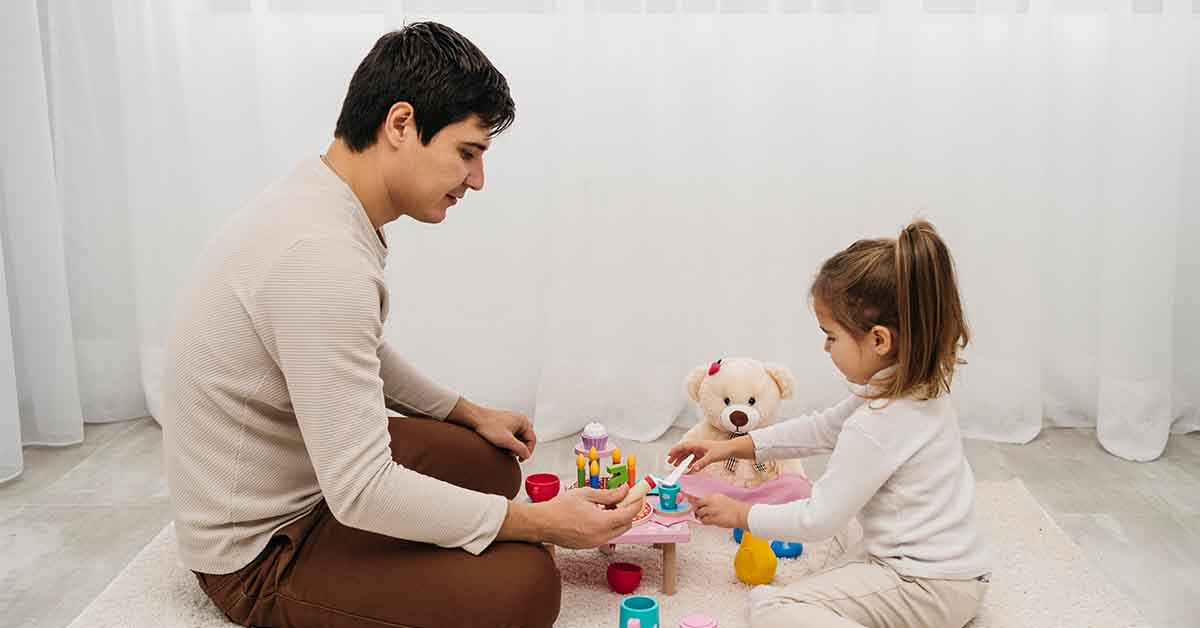
Throughout your child’s early life, they’ll go through a number of distinct phases in their approaches to communication, play, and life as a whole. Each of these phases have a distinct and extremely important role in their development and can have long-term effects on what sort of person they grow up to become. As a parent, it’s only natural that you want to know what these phases are, why they’re important, and how you can set your child up for success. To help you out, we’re going to be covering one of the most important phases: pretend play.
What Is Pretend Play?
Pretend play is exactly what it sounds like: play activities in imaginary scenarios. Imaginary play can take several forms, and may involve props, toys, or even other children. However, many children will engineer pretend play games and scenarios entirely for themselves, and can keep themselves entertained for hours at a time by doing so. While it may seem strange from the outside, it actually serves an incredibly important purpose in many key developmental areas for your child.
When Do Children Start Pretend Play?

If your child is developmentally on track, they should typically start pretend play around 1 ½ to 2 years of age. At this point, they may engage in object substitution, (pretending a stick is a sword, a banana is a phone, etc.) create imaginary friends, or imagine pretend scenarios and settings. When playing with similarly aged children, they may draw their peers into these scenarios as well. It typically persists throughout childhood and into early adolescence, ending around age 11.
So, if your child is taking longer than average to start or stop engaging in pretend play, is that cause for concern? Not necessarily. Some children may take longer than others to start engaging in pretend play, with many late bloomers beginning around age 3. If your child hasn’t started by age 3, though, many experts recommend speaking to a professional. While it may be nothing, a lack of interest in pretend play can be a symptom of Autism Spectrum Disorder, or ASD. While autistic children do think and approach the world differently than their neurotypical peers, getting an early diagnosis can help you to offer the unique resources and support that they need in order to thrive.
As for when pretend play should stop, there’s no concrete age. It typically declines around age 11 as our thought patterns start to become more structured and rigid, but for some people, it never truly stops. Think about Dungeons & Dragons, for example. Though it’s dressed up as a role-playing game and marketed towards teens and young adults, it’s still just a more structured form of pretend play at its core. All that to say, there’s no need for concern if your child continues to engage into pretend play throughout adolescence or even into adulthood as long as it’s not stunting their real-life social interactions. With that key info out of the way, though, let’s get into some of the specific benefits of pretend play.
Developing Imagination and Creativity

Children are still discovering the concepts of imagination and creativity when they discover pretend play, and engaging in pretend scenarios helps them to develop those concepts. By weaving complex characters, scenarios, and settings early in childhood, they can gain a lifelong appreciation of storytelling, art, and creativity in general.
Improving Social Skills
You’ve probably heard that children learn through play, and this holds true for pretend play. When children play pretend with their peers, they may invent scenarios with conflicts that need to be resolved. By resolving these imaginary conflicts, they can learn new ways to resolve similar conflicts in reality. For example, if they can settle an argument over which sections of the yard each child gets for their imaginary kingdom, they can hash out a real-world conflict over something like sharing toys.
Forming a Stronger Sense of Identity

At this stage in their development, children are still trying to figure out who they are and who they want to be. Naturally, having access to an imaginary world where they can be anything they want is extremely helpful. If your child wants to grow up to be a helper, someone who listens to people when they’re down and does whatever they can to help them get up again, this will likely be reflected in their pretend play. They may, for example, pretend to be a doctor who gives important treatments to their stuffed animals. If they want to grow up to be a leader, they may pretend to be a king or queen. Essentially, pretend play in fun scenarios can help your child figure out the sort of person they most enjoy being, giving them a sense of direction in life as they work to bring their imaginary self into reality.
Looking for more great tips, tricks, and products to help your child grow and learn through play? Come visit our site at ToysCentral today!